
New Publication by Henrik Huizinga and Rosalie van Dijken in the International Journal if Pharmaceutics

Our latest publication by Henrik Huizinga and Rosalie van Dijken et. al. entitled “Roadmap for the accelerated development and clinical translation of fluorescent tracers: Adalimumab-680LT as a proof of concept” can be found here.
Abstract
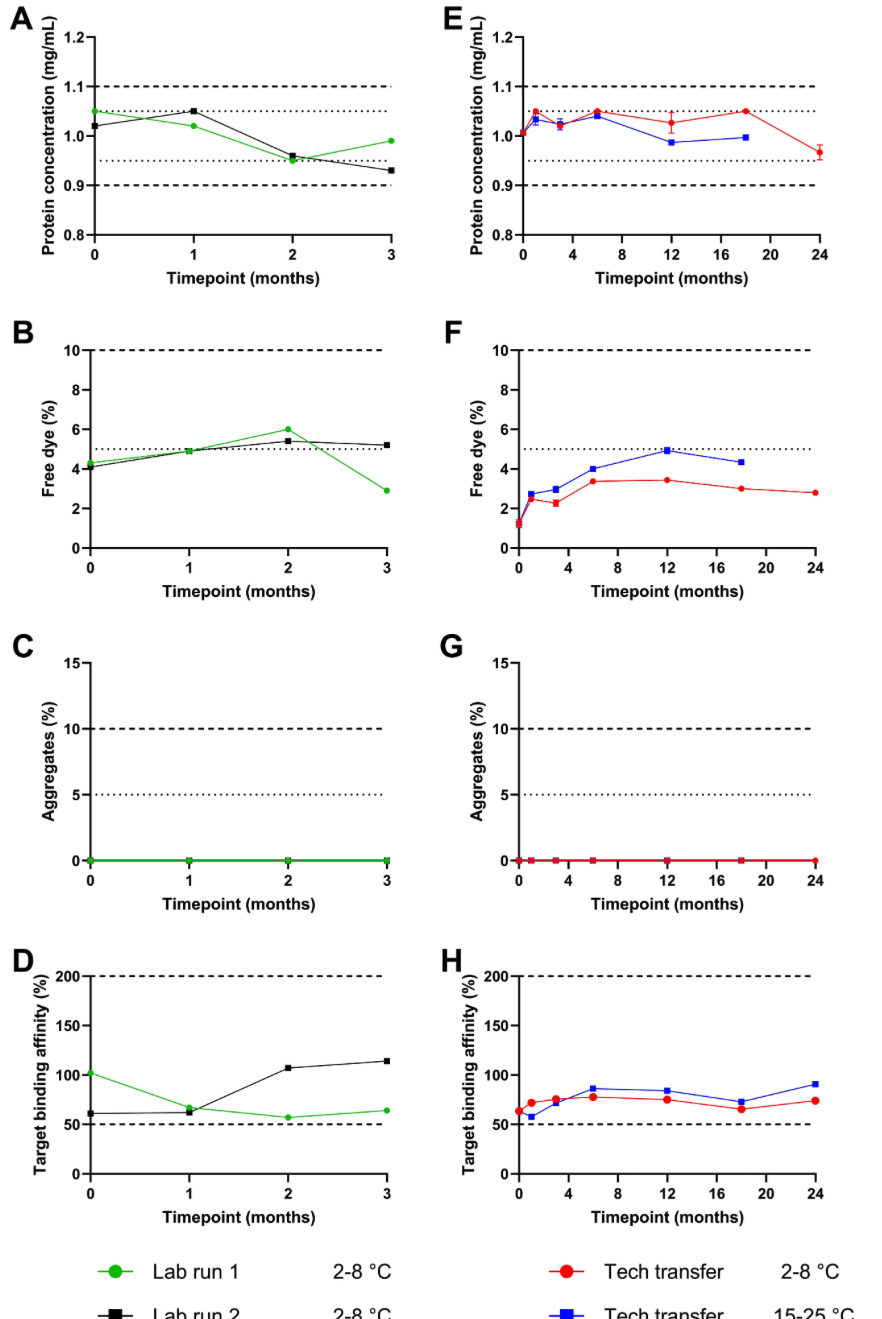
Fluorescence molecular imaging (FMI), using fluorescent labelled antibodies, can provide insight into local drug distribution, identification of target cells and target engagement. However, clinical translation of novel fluorescent tracers is hampered by their extensive and time-consuming development process, highlighting the need for an accelerated and standardised process. This study presents a general roadmap for accelerated fluorescent tracer development and clinical translation and compares it to the original development process. The accelerated development process introduced feasibility testing, to minimize small-scale experiments, while the introduction of lab runs, combined with a technology transfer, allowed for earlier collection of stability data, further accelerating the development process. Accordingly, adalimumab-680LT was developed as a proof of concept using this accelerated roadmap. Development was mainly performed using labelling parameters, analytical methods, and QC-tests of previously developed tracers and building upon this experience. Adalimumab was successfully conjugated to IRDye 680LT under current Good Manufacturing Practice (cGMP) conditions. Feasibility testing and small-scale experiments yielded a robust and cGMP-compliant production process, with label efficiencies of 82.8 ± 2.9%. Short- and long-term stability was demonstrated in stability studies up to 24 months, with a target binding affinity between 58 and 86%, and a monomer concentration between 0.97 and 1.05 mg/mL. Following the accelerated roadmap, adalimumab-680LT could already be used in phase I/II clinical trials in humans 12 months after the first experiments, a time reduction of 40%, or 8 months. From this point forward, the described roadmap can be applied to develop novel clinical-grade antibody-based fluorescent tracers, saving valuable time and resources.
Keywords: accelerated drug development, fluorescent labelled antibodies, adalimumab-680LT